Sunday, 10 January 2016

ABOUT THE AUTHOR:


John Webster (c. 1580 – c. 1634) was an English Jacobean dramatist best known for his tragedies The White Devil and The Duchess of Malfi, which are often regarded as masterpieces of the early 17th-century English stage.His life and career overlapped William Shakespeare's.
Webster's life is obscure, and his date-of-birth and death date are not known. His father, a carriage maker also named John Webster, married a blacksmith's daughter named Elizabeth Coates on 4 November 1577, and it is likely that Webster was born not long after in or near London. The family lived in St. Sepulchre's parish. Father John, and Uncle, Edward Webster, were Freemen of the Merchant Taylors' Company and Webster attended Merchant Taylors' School in Suffolk Lane, London.On 1 August 1598, "John Webster, lately of the New Inn" was admitted to the Middle Temple, one of the Inns of Court; in view of the legal interests evident in his dramatic work, this is possibly the playwright. Webster married the 17-year-old Sara Peniall on 18 March 1606 at St Mary's Church, Islington. A special licence had to be obtained to permit a wedding in Lent, which was necessary as at the date of their marriage, Sara was seven months pregnant. Their first child, John, was baptised at the parish of St Dunstan-in-the-West on 8 March 1605 or 1606. Bequests in the will of a neighbour who died in 1617, indicate that other children were born to him.
Most of what is otherwise known of him relates to his theatrical activities. Webster was still writing plays as late as the mid-1620s, but Thomas Heywood's Hierarchie of the Blessed Angels (licensed 7 November 1634) speaks of him in the past tense, implying he was then dead.

SUMMARY:


The Duchess of Malfi takes place in Italy, mostly at the Duchess’s palace in Malfi, in the sixteenth century. The Duchess is a young widow whose two brothers, Ferdinand and the Cardinal, are visiting her from Rome at the play’s start. Antonio, the manager of her household, has just returned from France. Before leaving the Duchess, Ferdinand engages Bosola, previously used by the Cardinal as a hit man, to ostensibly manage the Duchess’s horses, but in reality to spy on her for the brothers so they can be sure she remains chaste and does not remarry. Bosola is reluctant, but eventually agrees.
Before they return to Rome, Ferdinand and the Cardinal lecture the Duchess about the impropriety of remarriage. She insists that she has no plans for remarriage, and shows some irritation at their attempts to control her. However, as soon as they leave, she sets in motion a plan to propose to Antonio with the help of her maid, Cariola. Antonio and the Duchess marry, and the Duchess reassures Antonio that they will find a way to appease her brothers.
Act Two is set about nine months later. The Duchess is pregnant and Bosola, suspecting her condition, hatches a plan to prove it to himself by giving her apricots, thought to induce labor. She accepts them, and immediately becomes ill, rushing off to her bedroom. Antonio and Delio discuss how to keep her labor secret.
Bosola now assumes his belief is correct, but finds further definitive proof through a horoscope Antonio wrote for the infant. With the information confirmed, Bosola he writes a letter to the Duchess’s brothers to tell them the news. The brothers are both incensed, but the Cardinal maintains a cool calm, whereas Ferdinand grows erratically angry. Neither of them realizes that she is married, and hence assume the baby is a bastard. Ferdinand says he won’t take any action until he knows who the baby’s father is.
Click To Buy
Act Three begins about two years later, with Delio’s return to the Duchess’s palace. Antonio and the Duchess have had two more children in the meantime. Ferdinand has recently arrived, and both Antonio and Delio suspect that he knows about the Duchess’s children. Ferdinand surprises the Duchess in her bedroom, and when she tells him that she is married, he tells her she should never reveal to him the name of her lover lest terrible violence then be unleashed on all of them. He further banishes her forever from his sight.
The Duchess, who wishes to protect Antonio by removing him from Malfi, falsely claims he has stolen from her and hence has him banished to Ancona. Once he has left, Bosola defends his virtue to the Duchess so emphatically that she admits the secret of their marriage. Bosola pretends to support her, and she sends him after Antonio with money and news that she will soon follow him. In Ancona a few days later, the Cardinal catches up to them and banishes the Duchess and her family from there.
On their way out of town, Bosola brings her an ostensibly forgiving but actually threatening letter from Ferdinand, and so the Duchess, fearing an ambush, tells Antonio to separate from her with their oldest son. Immediately after they part, Bosola and a group of soldiers take the Duchess and her two remaining children captive and bring them back to her palace.
In Act Four, Bosola tells Ferdinand that the Duchess is bearing her imprisonment nobly, which angers him. In an effort to make her insane with despair, he presents her with wax corpses of her family to convince her they have died. Though Bosola pleas with Ferdinand to cease his torture, he won’t listen, and instead sends a group of madmen to torment her. Bosola returns, disguised as a tomb-maker, and prepares the Duchess for her impending death. Executioners follow with a cord to strangle her, but the Duchess remains steadfastly calm and courageous, at peace with the idea of rejoining her family, who she still believes are dead. They strangle her.
Bosola next orders her children and Cariola killed. Cariola pleads for her life, to no avail. When Ferdinand confronts the Duchess’s body, he is suddenly overtaken with remorse and angry at Bosola for following his orders. He not only betrays Bosola by refusing the latter a promised reward, but also shows signs of insanity before he exits. The Duchess shows a final sign of life, and before she truly dies, Bosola tells her that Antonio is still alive. Bosola shows genuine sadness when she dies.
In Act Five, Antonio, ignorant of his wife and children’s deaths, plans to beg the Cardinal that night for a reconciliation. Ferdinand has now completely lost his mind and is afflicted with lycanthropia, or the belief that he is a wolf.
Bosola arrives and the Cardinal pretends that he has no idea about the Duchess's death. He offers Bosola a great reward for the murder of Antonio, an offer Bosola accepts even though he is plotting revenge. Julia, the Cardinal’s mistress, approaches Bosola, declaring her love for him, and Bosola uses her to get the Cardinal to admit his involvement in the Duchess's murder.
After the Cardinal kills Julia, Bosola reveals he has overheard the secret and demands his reward killing the Duchess. The Cardinal, once again, promises it will come after he has killed Antonio and helped him get rid of Julia’s body. Bosola pretends to agree, but tells the audience that he will find Antonio to either protect him or help him get his vengeance against the Cardinal and Ferdinand.
The Cardinal tells his courtiers to stay away no matter what they hear from him or Ferdinand, ostensibly because Ferdinand’s madness gets worse when people are around, but actually because he wants privacy with which to dispose of Julia’s body. Bosola, waiting outside the Cardinal’s room, accidentally kills Antonio, who has come to see the Cardinal. Distraught, he goes into the Cardinal’s room and attacks him.
Because of the Cardinal’s warning, his courtiers at first ignore his cries for help. Ferdinand joins the fray and stabs both the Cardinal and Bosola. Bosola kills Ferdinand. The courtiers finally enter in time to see the Cardinal and Bosola die, but not before the latter has confessed the particulars of the situation. Delio enters with Antonio and the Duchess’s oldest son, who is the sole survivor of the family. Delio and the courtiers promise to raise the boy as a legacy to his parents, which gives the play a final glimmer of hope.


Continue reading

ABOUT THE AUTHOR:


William Shakespeare (26 April 1564 (baptised) – 23 April 1616)was an English poet, playwright, and actor, widely regarded as the greatest writer in the English language and the world's pre-eminent dramatist.He is often called England's national poet, and the "Bard of Avon". His extant works, including collaborations, consist of approximately 38 plays,154 sonnets, two long narrative poems, and a few other verses, some of uncertain authorship. His plays have been translated into every major living language and are performed more often than those of any other playwright.
Shakespeare was born and brought up in Stratford-upon-Avon, Warwickshire. At the age of 18, he married Anne Hathaway, with whom he had three children: Susanna, and twins Hamnet and Judith. Sometime between 1585 and 1592, he began a successful career in London as an actor, writer, and part-owner of a playing company called the Lord Chamberlain's Men, later known as the King's Men. He appears to have retired to Stratford around 1613, at age 49, where he died three years later. Few records of Shakespeare's private life survive, which has stimulated considerable speculation about such matters as his physical appearance, sexuality, and religious beliefs, and whether the works attributed to him were written by others.

SUMMARY:


The complicated plot of Antony and Cleopatra has numerous twists and turns, and takes us across an ocean and back several times. We begin in Egypt with Mark Antony, one of the three leaders (or triumvirs) of the Roman Republic, reveling with his powerful lover Cleopatra, the Queen of Egypt. This drunken merry-making is getting in the way of his being an effective ruler in Rome, and the people at home are beginning to resent it. He gets news that his wife, Fulvia, alongside his brother, has been making war against the other triumvirs, and also that Sextus Pompeius, son of Pompey the Great (a former ruler of Rome), is threatening Rome as well. Also, there are pirates. Argh!
Antony finds out that his wife is dead, which solves the war problem—but he really does need to be getting back to Rome to address the Pompey situation. He leaves Egypt with Cleopatra’s half-hearted blessing and begins to fix stuff back home in Rome. He and Octavius Caesar (another triumvir) have a fight about the personal things between them, and decide to fix the situation by marrying off Caesar’s sister, Octavia, to Antony. Even though Antony hasn’t proven to be Mr. Marrying-Kind, the idea is that Octavia will form a bond between the two men—because she loves them both, they’ll love each other. It’s not two minutes before Antony meets with a soothsayer who tells him to get away from Caesar, because Caesar mutes his power. Antony agrees that he should head back to Egypt, where his pleasure lies. 
Then, the triumvirs meet with Pompey to see if they can negotiate instead of going to war. Pompey is fighting to avenge his father’s death, but he gives in to the others and makes a truce. They agree that he gets a little piece of southern Italy, as long as he gives wheat to the Romans. They all celebrate drunkenly onboard Pompey’s ship that night. One of Pompey’s servants, Menas, suggests that they kill the drunk triumvirs while they have them, but Pompey is too honest to do this (though he wouldn’t have minded if someone else had done it without involving him). Murder aside, they go back to drinking. So much partying goes down that Lepidus (the third triumvir) gets carted out of drunken scene.
Click To Buy
Later, the plan is for Antony is to head back to Athens with his new bride while Caesar stays in Rome. Caesar charges Antony to take good care of his sister, and Antony promises to do so. Also, Antony’s men have been fighting a war in Parthia (modern-day Iraq) with good success, even without his leadership. Back in Egypt, Cleopatra has found out about Antony’s marriage, whipped the messenger, threatened to stab him, and then sent him to see if Octavia’s assets rival her own. Cleopatra is pleased to find out that Octavia looks plain, since it means she has a good chance of winning Antony back. 
Back in Athens, Antony reports to Octavia that Caesar has already violated the pact with Pompey, is trash-talking Antony in public, and has dismissed Lepidus from office. Antony can’t abide by this and needs to fight for his honor. Octavia is torn between her brother and her husband, and asks to go back to Rome to see if she can make peace with her brother. Antony sends her off, and then promptly heads back to Egypt to begin preparing war for and also to hang out with his lover.
In Egypt, Cleopatra lends her ships to Antony while he gets ready to meet Caesar at sea. Although it’s not his arena of choice, Antony’s going for the sea showdown because Caesar has challenged him to a face-off on the ocean and he doesn’t want to be a chicken. Cleopatra stubbornly refuses to sit at home while all the action is outside, but once in the battle, even as things are looking up for Antony’s side, she runs away. Antony, essentially whipped, follows her and totally forfeits the battle. He admits she’s conquered his heart, and laments that he’s no longer a soldier. But then she gives him a kiss. He sends a schoolmaster, his children’s tutor, to give conditions of surrender to Caesar. He asks to either be left alone in Egypt, or to be allowed to be a private citizen in Athens. 
Caesar won’t grant any of Antony’s wishes, but says Cleopatra can have anything she wants if she’ll either exile Antony or have him murdered in Egypt. Hearing this, Antony is not a happy camper, and resolves to murder Caesar in hand-to-hand combat (no more of this sea business). While he goes off to write an "I’m going to murder you in hand-to-hand combat" letter, another messenger from Caesar (named Thidias) slips in. This guy is supposed to use his cunning linguistic skills to whet Cleopatra’s appetite for treachery against Antony. She’s just about to give her allegiance to Caesar when Antony walks in, has Thidias whipped, and gives Cleopatra a piece of his mind. She says she’s sorry, and he forgives her. Then they party hard, preparing for a new battle the next day. 
We learn that Enobarbus, Antony’s loyal friend, has defected to Caesar’s camp because he thinks even Cleopatra has abandoned Antony (seeing her flirt with Thidias). He thinks Antony has no chance of winning. Later that same night, soldiers on watch hear strange music playing, and they conclude that this is the sound of Hercules (an ancestor of Antony’s) abandoning Antony.
The next morning, everyone is in high spirits about battle. Antony hears that Enobarbus has fled and instead of being angry he feels sorry for the guy, sending treasure chests after him. He laments that his own bad fortune has driven Enobarbus to switch teams. In that day’s battle, Antony soundly trounces Caesar’s troops, and there’s much celebrating. Antony is all courage again, and they have a big march in Alexandria, which they’ve won back. Meanwhile, Enobarbus stands under the moon and laments his broken heart. He regrets that he’s betrayed Antony, and wishes the world to remember him as the worst traitor ever. Some soldiers are watching him, unnoticed, and see him die of a broken heart. 
It’s morning again, and perhaps with renewed courage from yesterday’s victory, Antony meets Caesar at sea. This time, he watches his fleet greet Caesar’s men as friends. Oops. The battle is lost and he’s furious. He blames Cleopatra, not the men, because he’s convinced that her treachery is at the root of his loss—she must have betrayed him to Caesar. He goes to the palace in a rage, resolving to kill her. 
Seeing her lover’s rage, Cleopatra flees to her monument and locks herself up. She has her servant send word to Antony that she’s killed herself, to see how he’ll respond. He responds by deciding to kill himself too—thinking it was noble of Cleopatra to be the one who decided when her life was over. He’d like to be his own conqueror. He asks his friend Eros to kill him, and Eros chooses to kill himself instead rather than go through with it. Antony then takes it upon himself to fall on his sword, and he’s done a bad job of it apparently, so he doesn’t die immediately. Just then Diomedes enters, bringing the news that Cleopatra isn’t really dead. Antony, hearing this, asks to be taken to her, so he can die near her. He’s not even that mad.
Antony, bleeding all over the place, tells Cleopatra she should yield herself to Caesar for her safety and honor. He says she can’t trust anyone around Caesar except this one guy, Proculeius. Cleopatra says she won’t trust anyone but her own resolution and her own hand, which seems to mean she’s going to kill herself. As Antony’s dying, he asks to be remembered as a noble Roman who was conquered by himself and no other, especially not Caesar. He dies, and Cleopatra beings the preparations to kill herself, too.
Just then, Caesar’s guy Proculeius comes into the monument to negotiate with Cleopatra and give her basically whatever she wants. She asks for her kingdom, Egypt, to be given to her son. As Proculeius leaves, Cleopatra is overtaken by some of Caesar’s guards. She tries to kill herself, but they’re fast and stop her. Dolabella, one of Caesar’s more kindhearted guys, takes over, pitying Cleopatra as she tells him of Antony’s greatness. Dolabella confirms her fear that Caesar means to make her a central attraction in his victory parade. Caesar shows up, and there’s an episode where Cleopatra claims to have given him all her treasure. Unfortunately, her treasurer says she lied, so fighting follows. Anyway, Caesar says she can keep her stuff, and she shouldn’t worry, as she will direct how the Romans will treat her. 
Once Caesar leaves, Dolabella tells Cleopatra that Caesar will send for her and her children in three days to be put in the victory march. Cleopatra wails that she doesn’t want to be breathed on and scowled at by filthy Romans. So, instead, she has a plan. She has her women dress her in her finest robes and then receives a rather harmless looking visitor. It turns out this harmless visitor brought her some figs in which he’s hidden some poisonous snakes (asp) at her request. Cleopatra, all dolled up, says she’s going to meet her husband (that would be Antony). She kisses Iras, her servant, who dies immediately. Then, she puts an asp to her breast, and says some insulting things about Caesar. As Charmian cries out that there is a snake on her breast, Cleopatra applies another asp to her arm and dies. Charmian is very sad about this, so naturally she fixes her lady’s crown. Just then, Caesar’s guard enters, so Charmian applies an asp to herself. She says Cleopatra’s work was befitting for a royal princess descended of many kings, and then she dies. 
Dolabella and then Caesar march in to find all the dead women, and wonder how they died. Dolabella discovers the wounds on Cleopatra’s chest and arms, and another guard finds the slimy trail of the poisonous snake in the figs. Caesar admits it was in Cleopatra’s royal nature to do what she pleased, and decrees that she’ll be buried next to Antony. The funeral will be attended by the solemn Romans, and then they’ll go back home to the former Roman Republic, which is now the new Roman Empire.


Continue reading

ABOUT THE AUTHOR:


Geoffrey Chaucer ( 1343 – 25 October 1400), known as the Father of English literature, is widely considered the greatest English poet of the Middle Ages and was the first poet to be buried in Poets' Corner of Westminster Abbey.
While he achieved fame during his lifetime as an author, philosopher, and astronomer, composing a scientific treatise on the astrolabe for his ten-year-old son Lewis, Chaucer also maintained an active career in the civil service as a bureaucrat, courtier and diplomat. Among his many works, which include The Book of the Duchess, the House of Fame, the Legend of Good Women and Troilus and Criseyde. He is best known today for The Canterbury Tales.
Chaucer was a crucial figure in developing the legitimacy of the vernacular, Middle English, at a time when the dominant literary languages in England were French and Latin.
Geoffrey Chaucer was born in London sometime around 1343, though the precise date and location of his birth remain unknown. His father and grandfather were both London vintners; several previous generations had been merchants in Ipswich.

SUMMARY:


Click To Buy
The Wife of Bath begins the Prologue to her tale by establishing herself as an authority on marriage, due to her extensive personal experience with the institution. Since her first marriage at the tender age of twelve, she has had five husbands. She says that many people have criticized her for her numerous marriages, most of them on the basis that Christ went only once to a wedding, at Cana in Galilee. The Wife of Bath has her own views of Scripture and God’s plan. She says that men can only guess and interpret what Jesus meant when he told a Samaritan woman that her fifth husband was not her husband. With or without this bit of Scripture, no man has ever been able to give her an exact reply when she asks to know how many husbands a woman may have in her lifetime. God bade us to wax fruitful and multiply, she says, and that is the text that she wholeheartedly endorses. After all, great Old Testament figures, like Abraham, Jacob, and Solomon, enjoyed multiple wives at once. She admits that many great Fathers of the Church have proclaimed the importance of virginity, such as the Apostle Paul. But, she reasons, even if virginity is important, someone must be procreating so that virgins can be created. Leave virginity to the perfect, she says, and let the rest of us use our gifts as best we may—and her gift, doubtless, is her sexual power. She uses this power as an “instrument” to control her husbands.
At this point, the Pardoner interrupts. He is planning to marry soon and worries that his wife will control his body, as the Wife of Bath describes. The Wife of Bath tells him to have patience and to listen to the whole tale to see if it reveals the truth about marriage. Of her five husbands, three have been “good” and two have been “bad.” The first three were good, she admits, mostly because they were rich, old, and submissive. She laughs to recall the torments that she put these men through and recounts a typical conversation that she had with her older husbands. She would accuse her -husband of having an affair, launching into a tirade in which she would charge him with a bewildering array of accusations. If one of her husbands got drunk, she would claim he said that every wife is out to destroy her husband. He would then feel guilty and give her what she wanted. All of this, the Wife of Bath tells the rest of the pilgrims, was a pack of lies—her husbands never held these opinions, but she made these claims to give them grief. Worse, she would tease her husbands in bed, refusing to give them full satisfaction until they promised her money. She admits proudly to using her verbal and sexual power to bring her husbands to total submission.


Continue reading

ABOUT THE AUTHOR:


William Shakespeare (26 April 1564 (baptised) – 23 April 1616) was an English poet, playwright, and actor, widely regarded as the greatest writer in the English language and the world's pre-eminent dramatist. He is often called England's national poet, and the "Bard of Avon". His extant works, including collaborations, consist of approximately 38 plays, 154 sonnets, two long narrative poems, and a few other verses, some of uncertain authorship. His plays have been translated into every major living language and are performed more often than those of any other playwright.
Shakespeare was born and brought up in Stratford-upon-Avon, Warwickshire. At the age of 18, he married Anne Hathaway, with whom he had three children: Susanna, and twins Hamnet and Judith. Sometime between 1585 and 1592, he began a successful career in London as an actor, writer, and part-owner of a playing company called the Lord Chamberlain's Men, later known as the King's Men. He appears to have retired to Stratford around 1613, at age 49, where he died three years later. Few records of Shakespeare's private life survive, which has stimulated considerable speculation about such matters as his physical appearance, sexuality, and religious beliefs, and whether the works attributed to him were written by others.

SUMMARY:


Orlando, the youngest son of the now deceased Sir Roland de Boys, complains to Adam, the old family retainer, that his eldest brother, Oliver, has kept his Inheritance from him — that is, Oliver has neglected training Orlando to be a proper gentleman. Oliver arrives on the scene, and a bitter quarrel takes place. Adam parts the fighting brothers, and Oliver coldly promises to give Orlando his due. Learning that Orlando intends to challenge Duke Frederick's champion wrestler, a brute of a man called Charles, Oliver makes plans to have his brother killed in the ring. He convinces the slow-witted Charles that Orlando is plotting against him and that Orlando should be killed.
At the match the next day, Duke Frederick, his daughter Celia, and his niece, Rosalind, watch Charles and Orlando wrestle. Charles has seriously injured his first three opponents, but in the match with Orlando, the young man's great speed and agility defeat the duke's champion. At first, Frederick is very cordial to Orlando, but when he learns the youth's identity, he becomes furious and leaves. The reason for the duke’s leaving is that Orlando's dead father, Sir Roland de Boys, had at one time been Frederick's bitter enemy.
After Frederick stalks out, Celia and Rosalind congratulate Orlando, and Rosalind makes it clear that she finds him most attractive. Orlando returns her feelings, but he is so tongue-tied with embarrassment that he can say nothing.
Click To Buy
At the ducal palace, we discover that Celia and her cousin Rosalind are as close as sisters; Rosalind is the daughter of the rightful duke, Duke Senior, whose throne has been usurped by his brother, Frederick. Frederick has banished Duke Senior, along with a band of his faithful followers, to the Forest of Arden to live the life of simple foresters. Until now, it is only the strong bond between Rosalind and Celia that prevents Duke Frederick from sending Rosalind away to share her father's exile. But suddenly, Frederick storms into the palace, accuses Rosalind of plotting against him, and, despite Celia's pleas for her cousin, banishes Rosalind. After her father leaves, Celia decides to go into exile with her cousin, and the girls set out for the Forest of Arden — Rosalind disguised as a young man, "Ganymede," and Celia disguised as a young country lass, "Aliena." Touchstone, Frederick's jester, accompanies them.
Meanwhile, Orlando returns home and is warned by the faithful Adam that Oliver is plotting to kill him. Together, they too decide to set out for the Forest of Arden, hoping that they will find safety there.
When his daughter Celia is missed, Frederick sends his men out to find Orlando. When he is informed of Orlando's flight to the Forest of Arden, Frederick assumes that Orlando is responsible for Celia's disappearance, and in a rage he sends for Oliver and commands him to find Orlando or else forfeit his entire estate to Frederick.
In the forest, Orlando and Adam join Rosalind's exiled father and his men, while Rosalind and Celia, still in disguise, purchase a little cottage and a small herd of sheep and settle down to a peaceful, pastoral existence. One day, however, Rosalind finds that the trees in the forest are all covered with sheets of poetry, dedicated to her. The author of these poems, of course, is Orlando. So, still pretending to be the young man Ganymede, Rosalind meets Orlando, who is in the throes of love-sickness for having apparently lost Rosalind. Ganymede offers to cure Orlando of his love-sickness by pretending to be his lady-love, Rosalind. Orlando, she says, should woo Ganymede as though "he" were Rosalind. In turn, Ganymede will do "his best" to act as moody and capricious as a girl might just do and, eventually, Orlando will weary of all the coy teasing and forget all about love — and Rosalind. Orlando agrees to try the plan.
Rosalind, meanwhile, continues to assume the guise of Ganymede and becomes accidentally involved in yet another complication: Silvius, a young shepherd, falls in love with Phebe, a hard-hearted shepherdess, but Phebe rejects Silvius' attentions and falls in love with the young, good-looking Ganymede.
In the midst of all this confusion, Oliver arrives in the Forest of Arden. He tells Ganymede of a near escape he has just had with death. His brother, Orlando, he says, saved him from being poisoned by a deadly snake as he slept, and later, Orlando killed a lioness that was ready to pounce on Oliver. Oliver then tells Ganymede that he has been sent to this part of the forest to seek out a young man known as Ganymede and tell him that Orlando cannot keep his appointment with him. And there is more news: while saving Oliver's life, Orlando was wounded. Hearing this, Ganymede swoons.
Later, in another part of the forest, Oliver and Celia meet and fall in love at first sight, and the jester, Touchstone, falls in love with a homely, simple-minded young woman named Audrey, who tends a herd of goats. Touchstone chases off Audrey's suitor, a lout named William, and although he realizes that he will never instill in Audrey any understanding of, or love for, such things as poetry, he still feels that he must have her.
Duke Frederick, meanwhile, is alarmed by the daily exodus of so many of the best men of his court to the alliance that is growing in the Forest of Arden; he therefore decides to journey to the forest himself and put a stop to all this business. At the forest's edge, however, he meets an old religious hermit and is miraculously converted.
At this point, Rosalind, still disguised as Ganymede, promises to solve the problems of everyone by magic. Shedding her male attire in private, she suddenly appears as herself, and the play comes to a swift close as she and Orlando, Oliver and Celia, Silvius and Phebe, and Touchstone and Audrey are married. Rosalind's father, the rightful duke, is joyous at finding his daughter again and is returned to his ducal status. Frederick's conversion is so complete that he renounces the world. At the end of the play, Rosalind comes forward and addresses the audience in a short but charming epilogue. In particular, she talks to all the lovers in the audience and wishes them well.

Continue reading

ABOUT THE AUTHOR:


Christopher Marlowe, also known as Kit Marlowe (26 February 1564 – 30 May 1593), was an English playwright, poet and translator of the Elizabethan era. Marlowe was the foremost Elizabethan tragedian of his day.He greatly influenced William Shakespeare, who was born in the same year as Marlowe and who rose to become the pre-eminent Elizabethan playwright after Marlowe's mysterious early death. Marlowe's plays are known for the use of blank verse and their overreaching protagonists.
A warrant was issued for Marlowe's arrest on 18 May 1593. No reason was given for it, though it was thought to be connected to allegations of blasphemy—a manuscript believed to have been written by Marlowe was said to contain "vile heretical conceipts". On 20 May he was brought to the court to attend upon the Privy Council for questioning. There is no record of their having met that day, however, and he was commanded to attend upon them each day thereafter until "licensed to the contrary." Ten days later, he was stabbed to death by Ingram Frizer. Whether the stabbing was connected to his arrest has never been resolved.

SUMMARY:


Faustus becomes dissatisfied with his studies of medicine, law, logic and theology; therefore, he decides to turn to the dangerous practice of necromancy, or magic. He has his servant Wagner summon Valdes and Cornelius, two German experts in magic. Faustus tells them that he has decided to experiment in necromancy and needs them to teach him some of the fundamentals.
When he is alone in his study, Faustus begins experimenting with magical incantations, and suddenly Mephistophilis appears, in the form of an ugly devil. Faustus sends him away, telling him to reappear in the form of a friar. Faustus discovers that it is not his conjuring which brings forth Mephistophilis but, instead, that when anyone curses the trinity, devils automatically appear. Faustus sends Mephistophilis back to hell with the bargain that if Faustus is given twenty-four years of absolute power, he will then sell his soul to Lucifer.
Click To Buy
Later, in his study, when Faustus begins to despair, a Good Angel and a Bad Angel appear to him; each encourages Faustus to follow his advice. Mephistophilis appears and Faust agrees to sign a contract in blood with the devil even though several omens appear which warn him not to make this bond.
Faustus begins to repent of his bargain as the voice of the Good Angel continues to urge him to repent. To divert Faustus, Mephistophilis and Lucifer both appear and parade the seven deadly sins before Faustus. After this, Mephistophilis takes Faustus to Rome and leads him into the pope's private chambers, where the two become invisible and play pranks on the pope and some unsuspecting friars.
After this episode, Faustus and Mephistophilis go to the German emperor's court, where they conjure up Alexander the Great. At this time, Faustus also makes a pair of horns suddenly appear on one of the knights who had been skeptical about Faustus' powers. After this episode, Faustus is next seen selling his horse to a horse-courser with the advice that the man must not ride the horse into the water. Later, the horse-courser enters Faustus' study and accuses Faustus of false dealings because the horse had turned into a bundle of hay in the middle of a pond.
After performing other magical tricks such as bringing forth fresh grapes in the dead of winter, Faustus returns to his study, where at the request of his fellow scholars, he conjures up the apparition of Helen of Troy. An old man appears and tries to get Faustus to hope for salvation and yet Faustus cannot. He knows it is now too late to turn away from the evil and ask for forgiveness. When the scholars leave, the clock strikes eleven and Faustus realizes that he must give up his soul within an hour.
As the clock marks each passing segment of time, Faustus sinks deeper and deeper into despair. When the clock strikes twelve, devils appear amid thunder and lightning and carry Faustus off to his eternal damnation.

Continue reading

ABOUT THE AUTHOR:


Christina Georgina Rossetti (5 December 1830 – 29 December 1894) was an English poet who wrote a variety of romantic, devotional, and children's poems. She is famous for writing Goblin Market and Remember, and the words of the Christmas carol In the Bleak Midwinter.
Christina Rossetti was born in Charlotte Street (now 105 Hallam Street), London, to Gabriele Rossetti, a painter and a political exile from Vasto, Abruzzo, and Frances Polidori, the sister of Lord Byron's friend and physician, John William Polidori. She had two brothers and a sister: Dante became an influential artist and poet, and William and Maria both became writers. Christina, the youngest, was a lively child. She dictated her first story to her mother before she had learned to write.
Rossetti was educated at home by her mother and father, who had her study religious works, classics, fairy tales and novels. Rossetti delighted in the works of Keats, Scott, Ann Radcliffe and Matthew Lewis. The influence of the work of Dante Alighieri, Petrarch and other Italian writers filled the home and would have a deep impact on Rossetti's later writing. Their home was open to visiting Italian scholars, artists and revolutionaries. The family homes in Bloomsbury at 38 and later 50 Charlotte Street were within easy reach of Madam Tussauds, London Zoo and the newly opened Regent's Park, which she visited regularly; in contrast to her parents, Rossetti was very much a London child, and, it seems, a happy one.

SUMMARY:


Click To Buy
Two sisters, Laura and Lizzie, hear the sounds of the goblin fruit market from their house. At first they try to ignore the enticing calls of the goblin men, but eventually Laura decides to go out and see what's happening. Lizzie warns her not to, but Laura is too curious. The goblin men offer her their fruit, and Laura thinks it looks tasty. She doesn't have any money, but the goblins offer to take a piece of her golden hair instead. So Laura gives up some of her hair, gorges herself on goblin fruit, and heads on home to her sister.

But after eating all that goblin fruit, Laura starts to waste away. Lizzie gets worried and decides to go down to the market to see what's what. The goblin men try to tempt her the way they tempted Laura, but Lizzie stands firm. The goblin men turn violent and try to stuff fruit in Lizzie's mouth, but she squeezes her mouth shut, so they just end up getting juice all over her. Lizzie runs back to their house all covered in goblin fruit juice. Laura kisses the juice off her sister's cheeks and is miraculously, but painfully, healed.

Years later, Laura and Lizzie are both wives and mothers, and they describe their experience in the goblin market to their own children as a cautionary tale about the importance of sisterly love.

Continue reading

ABOUT THE AUTHOR:


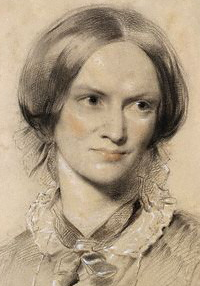
Charlotte Brontë (21 April 1816 – 31 March 1855) was an English novelist and poet, the eldest of the three Brontë sisters who survived into adulthood and whose novels have become classics of English literature. She first published her works (including her best known novel, Jane Eyre) under the pen name Currer Bell.
Jane Eyre had immediate commercial success and initially received favourable reviews. G. H. Lewes wrote that it was "an utterance from the depths of a struggling, suffering, much-enduring spirit," and declared that it consisted of "suspiria de profundis!" (sighs from the depths). Speculation about the identity and gender of the mysterious Currer Bell heightened with the publication of Wuthering Heights by Ellis Bell (Emily) and Agnes Grey by Acton Bell (Anne). Accompanying the speculation was a change in the critical reaction to Charlotte's work, as accusations were made that the writing was "coarse", a judgement more readily made once it was suspected that Currer Bell was a woman. However, sales of Jane Eyre continued to be strong and may even have increased as a result of the novel developing a reputation as an "improper" book.

SUMMARY:


Jane Eyre is the story of a young, orphaned girl (shockingly, she’s named Jane Eyre) who lives with her aunt and cousins, the Reeds, at Gateshead Hall. Like all nineteenth-century orphans, her situation pretty much sucks.
Mrs. Reed hates Jane and allows her son John to torment the girl. Even the servants are constantly reminding Jane that she’s poor and worthless. At the tender age of ten, Jane rises up against this treatment and tells them all exactly what she thinks of them. She’s punished by being locked in "the red room," the bedroom where her uncle died, and she has a hysterical fit when she thinks his ghost is appearing. After this, nobody knows what to do with her, so they send her away to a religious boarding school for orphans—Lowood Institute.
At Lowood, which is run by the hypocritical ogre Mr. Brocklehurst, the students never have enough to eat or warm clothes. However, Jane finds a pious friend, Helen Burns, and a sympathetic teacher, Miss Temple. Under their influence, she becomes an excellent student, learning all the little bits and pieces of culture that made up a lady’s education in Victorian England: French, piano-playing, singing, and drawing.
Unfortunately, an epidemic of typhus breaks out at the school, and Helen dies—but of consumption, not typhus. (We always knew she’d be a martyr.) Jane remains at Lowood as a student until she’s sixteen, and then as a teacher until she’s eighteen. When Miss Temple leaves the school to get married, Jane gets a case of wanderlust and arranges to leave the school and become a governess.
Click To Buy
The governess job that Jane accepts is to tutor a little French girl, Adèle Varens, at a country house called Thornfield. Jane goes there thinking that she’ll be working for a woman named Mrs. Fairfax, but Mrs. Fairfax is just the housekeeper; the owner of the house is the mysterious Mr. Rochester, and he's Adèle's guardian, although we’re not sure whether she’s his daughter. Jane likes Thornfield, although not the third floor, where a strange servant named Grace Poole works alone and Jane can hear eerie laughter coming from a locked room.
One evening when Jane’s out for a walk, she meets a mysterious man when his horse slips and he falls—of course, this is Mr. Rochester. Jane and Rochester are immediately interested in each other. She likes the fact that he’s craggy, dark, and rough-looking instead of smooth and classically handsome. She also likes his abrupt, almost rude manners, which she thinks are easier to handle than polite flattery. He likes her unusual strength and spirit and seems to find her almost unworldly; he’s always comparing her to a fairy or an elf or a sprite.
Rochester quickly learns that he can rely on Jane in a crisis—one evening, Jane finds Rochester asleep in his bed with the curtains and his bedclothes on fire, and she puts out the flames and rescues him. Jane and Rochester have fascinating conversations in the evenings and everything seems to be going really well… until Rochester invites a bunch of his rich friends to stay at Thornfield, including the beautiful Blanche Ingram. Rochester lets Blanche flirt with him constantly in front of Jane to make her jealous and encourages rumors that he’s engaged to Blanche. Don't worry, though—it's really only Jane he wants.
During the weeks-long house party, a man named Richard Mason shows up, and Rochester seems afraid of him. At night, Mason sneaks up to the third floor and somehow gets stabbed and bitten (ew). Rochester asks Jane to tend Richard Mason's wounds secretly while he fetches the doctor. The next morning before the guests find out what happened, Rochester sneaks Mason out of the house.
Before Jane can discover more about the mysterious situation, she gets a message that her Aunt Reed is very sick and is asking for her. Jane, forgiving Mrs. Reed for mistreating her when she was a child, goes back to take care of her dying aunt. When Jane returns to Thornfield, Blanche and her friends are gone, and Jane realizes how attached she is to Mr. Rochester. Although he lets her think for a little longer that he’s going to marry Blanche, eventually Rochester stops teasing Jane and proposes to her. She blissfully accepts.
Everything seems to be going great... until we notice that there’s still a third of the book left. That means something bad is about to happen.
It's the day of Jane and Rochester's wedding. It should be the happiest day of Jane's life, but during the church ceremony two men show up claiming that Rochester is already married. Dum dum dummm. Rochester admits that he is married to another woman, but tries to justify his attempt to marry Jane by taking them all to see his wife.
Mrs. Rochester is Bertha Mason, the "madwoman in the attic" who tried to burn Rochester to death in his bed, stabbed and bit her own brother (Richard Mason), and who’s been doing other creepy things at night. Rochester was tricked into marrying Bertha fifteen years ago in Jamaica by his father, who wanted him to marry for money and didn't tell him that insanity ran in Bertha’s family. Rochester tried to live with Bertha as husband and wife, but she was too horrible, so he locked her up at Thornfield with a nursemaid, Grace Poole.
Meanwhile, he traveled around Europe for ten years trying to forget Bertha and keeping various mistresses. Adèle Varens (Jane's student) is the daughter of one of these mistresses, though she may not be Rochester’s daughter. Eventually he got tired of this lifestyle, came home to England, and fell in love with Jane.
After explaining all this, Rochester claims that he’s not really married because his relationship with Bertha isn’t a real marriage. The main problem is that he can’t divorce her (because it was pretty tough to get a divorce at all in the Victorian period, and Bertha’s behavior isn’t grounds for a divorce, since she’s mentally ill and therefore not responsible for her actions). He wants Jane to go and live with him in France, where they can pretend to be a married couple and act like husband and wife. Jane refuses to be his next mistress and runs away before she’s tempted to agree.
Jane travels in a random direction away from Thornfield. Having no money, she almost starves to death before being taken in by the Rivers family, who live at Moor House near a town called Morton. The Rivers siblings—Diana, Mary, and St. John—are about Jane’s age and well-educated, but somewhat poor. They take whole-heartedly to Jane, who has taken the pseudonym "Jane Elliott" so that Mr. Rochester can’t find her. Jane wants to earn her keep, so St. John arranges for her to become the teacher in a village girls’ school.
When Jane’s uncle Mr. Eyre dies and leaves his fortune to his niece, it turns out that the Rivers siblings are actually Jane’s cousins, and she shares her inheritance with the other three. (Now she’s Jane Heir, hey-o.)
St. John, who is a super-intense clergyman, wants to be more than Jane’s cousin (back when that wasn't considered gross). He admires Jane’s work ethic and asks her to marry him (how un-romantic), learn Hindustani, and go with him to India on a long-term missionary trip. Jane is tempted because she thinks she’d be good at it and that it would be an interesting life. Still, she refuses because she knows she doesn’t love St. John. To top it off, St. John actually loves a different a girl named Rosamond Oliver, but he won’t let himself admit it because he thinks she would make a bad wife for a missionary.
Jane offers to go to India with him, but just as his cousin and co-worker, not as his wife. St. John won't give up and keeps pressuring Jane to marry him. Just as she’s about to give in, she supernaturally hears Mr. Rochester’s voice calling her name from somewhere far away.
The next morning, Jane leaves Moor House and goes back to Thornfield to find out what’s going on with Mr. Rochester. She finds out that Mr. Rochester searched for her everywhere and, when he couldn’t find her, sent everyone else away from the house and shut himself up alone. After this, Bertha set the house on fire one night and burned it to the ground. Rochester rescued all the servants and tried to save Bertha, too, but she committed suicide and he was injured. Now Rochester has lost an eye and a hand and is blind in the remaining eye.
Jane goes to Mr. Rochester and offers to take care of him as his nurse or housekeeper. What she really hopes is that he'll ask her to marry him—and he does. They have a quiet wedding, and after two years of marriage Rochester gradually gets his sight back. St. John Rivers, meanwhile, goes to India alone and works himself to death there over the course of several years.

Continue reading